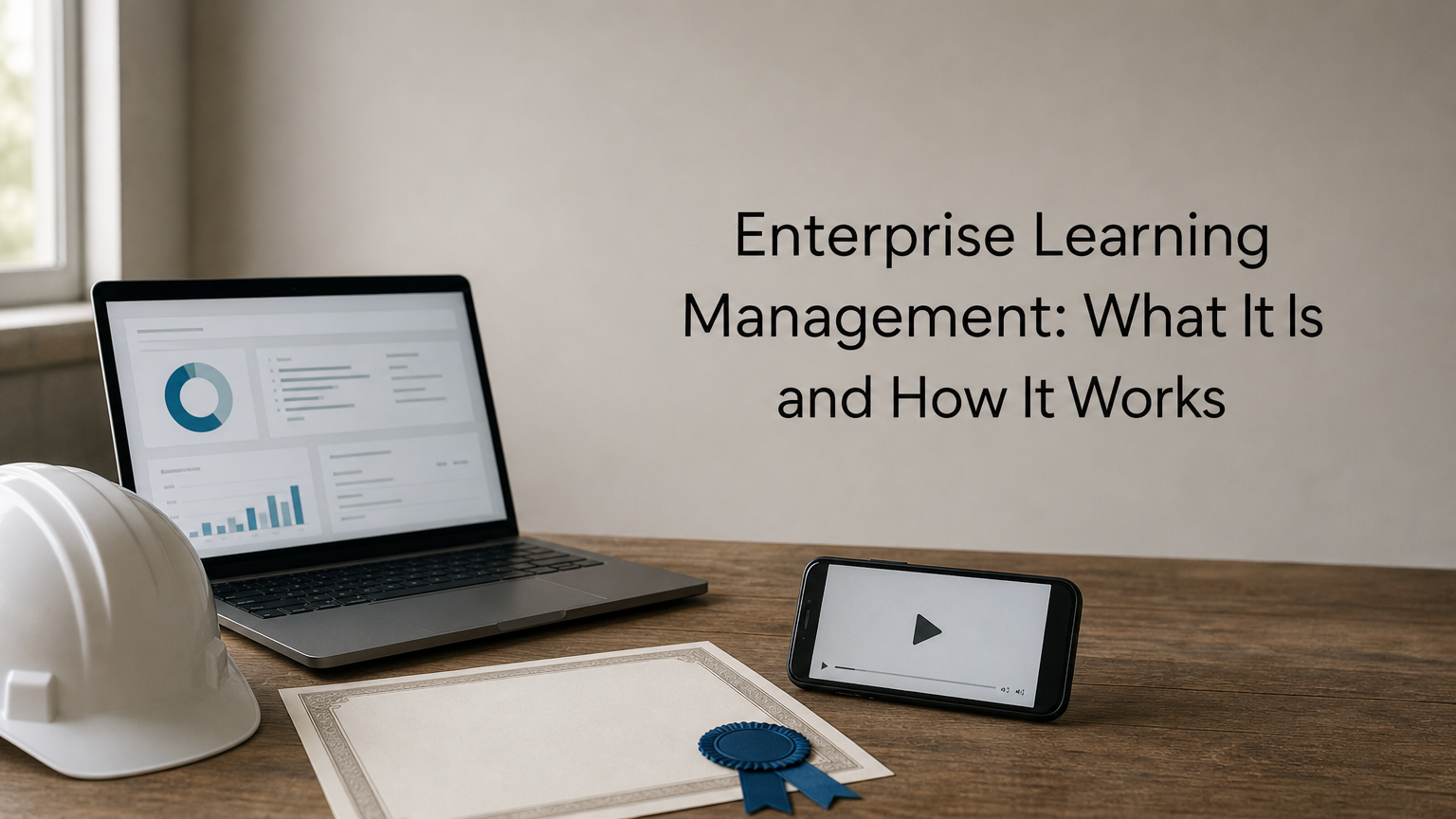
Enterprise learning management is the practice of planning, delivering, tracking and improving training across a whole organization, so every employee, and often partners and customers, gets the right knowledge when they need it. It combines four things: people, process, content and technology. A learning management system (LMS) is usually the software at the center. In South Africa you can run it on a cloud LMS, a self-hosted platform, an external training provider, or a mix of these.
This article explains why it matters, how to build it step by step, how to choose an LMS, and which training providers are worth a look if you operate in Gauteng. You will also find a worked example using the Skills Development Levy, so you can see how the figures apply to a company of your size.
QuikeFix is a South African business technology provider covering hosting, managed IT, cybersecurity and workflow automation. We are not a training provider. We work on the layer underneath any learning platform: servers, access control, integrations and support. That is where many LMS projects succeed or stall, so we write from that practical angle.
Why enterprise learning management matters
Enterprise learning management matters because training that nobody tracks costs money and changes little. A managed system shows you who has learned what, where the gaps are, and whether the training moved a business result.
Training without a system leaves you blind
When training lives in email threads, spreadsheets and one-off workshops, you cannot answer basic questions. Who completed the safety induction? Which managers skipped the data privacy refresher? Which branch lacks a skill? Spreadsheets break at scale, usually around the point where you have several sites and more than one person updating them.

The scope also reaches beyond staff. A freight forwarder may need to train agents, drivers or customers on a portal, and a manufacturer may need to certify distributors. Learning for partners and customers is part of the same discipline.
Training you cannot track is training you cannot prove, defend or improve.
Compliance and levy pressure in South Africa
Employers with an annual payroll above R500,000 pay the Skills Development Levy of 1% of payroll. Take a company with a R12 million annual payroll. It pays R120,000 a year (R12,000,000 × 1%). A portion can be claimed back through your SETA when you submit a Workplace Skills Plan and an Annual Training Report. Confirm the current grant rules with your SETA.
Those submissions need clean training records, and a managed system produces them as a by-product. The Protection of Personal Information Act (POPIA) adds another reason. Learner records are personal information, so where the data is hosted and who can access it are real decisions.
What improves when learning is managed
You can expect concrete gains once the basics are in place:
- Onboarding becomes consistent across branches, instead of depending on whoever trains the new hire.
- Compliance training has an audit trail you can show to a client or regulator.
- Skill gaps show up by team, so you spend budget where it matters.
- Knowledge stops living in one person’s head.
How to build enterprise learning management that works
You build it by starting with business problems and only then choosing tools. Follow the six steps below, and keep the first rollout small enough to finish.
The four parts of the system
Every working setup answers four questions, and a gap in any one of them is why many programs fail.
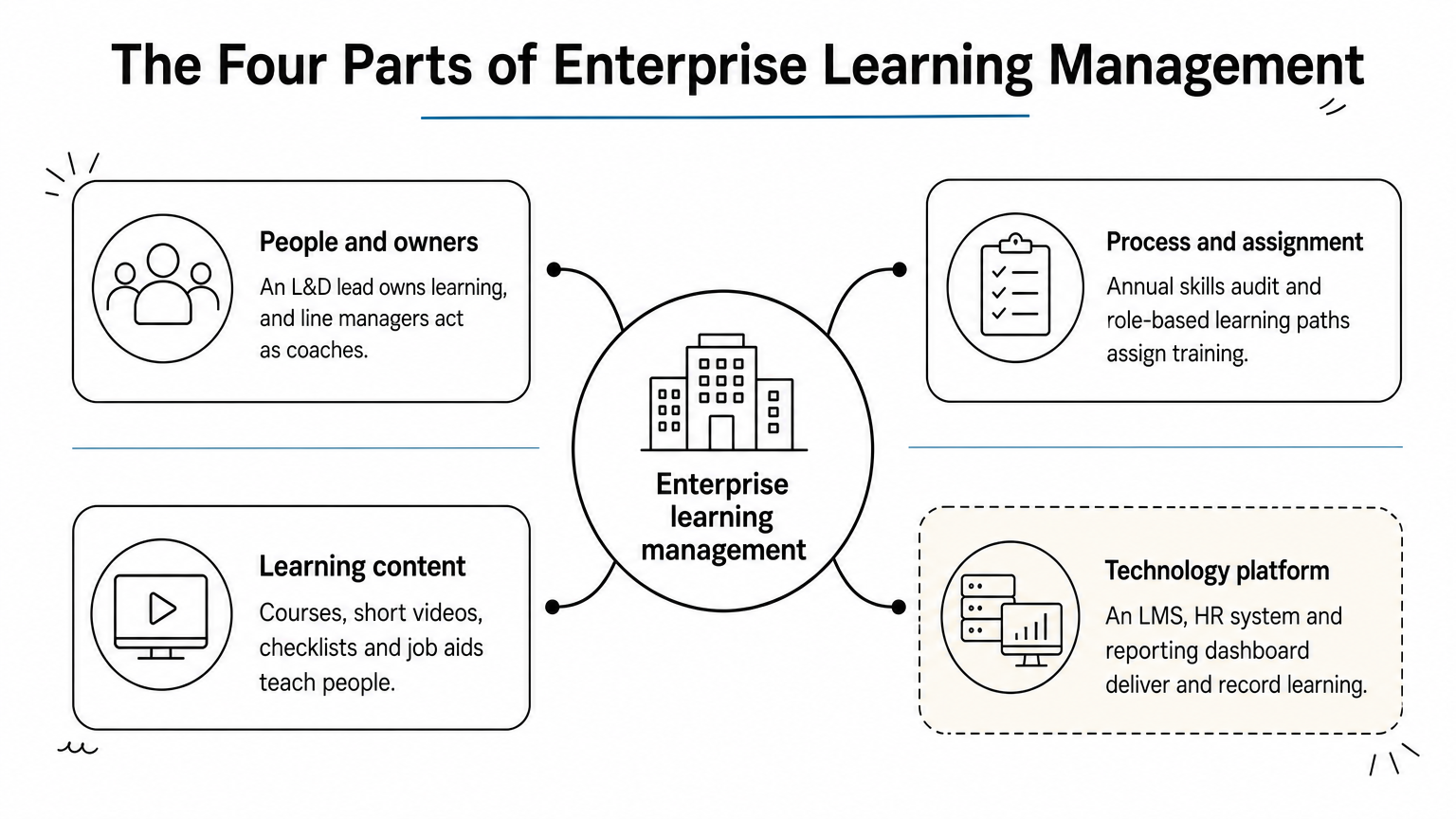
| Part | Question it answers | Example |
|---|---|---|
| People | Who owns learning, and who learns? | An L&D lead, line managers as coaches |
| Process | How are needs found and training assigned? | Annual skills audit, role-based learning paths |
| Content | What do people learn from? | Courses, short videos, checklists, job aids |
| Technology | Where is it delivered and recorded? | LMS, HR system, reporting dashboard |
Six steps to put it in place
- Audit needs. List compliance duties, role skills and the problems managers complain about.
- Set two or three measurable goals. Examples are onboarding time, incident rates or certification coverage.
- Assign owners. One person owns the program, and managers own learning for their teams.
- Sort your content. Decide what you build, what you buy and what an external provider delivers.
- Pick the platform. Choose it after steps 1 to 4, using the criteria in the next section.
- Pilot, then scale. Start with one department or one course, fix the friction, then widen the rollout.
Measuring whether it works
Track completion, assessment scores and time to competence. Then link them to a business metric such as fewer rework errors or shorter ramp-up for new staff. If your platform supports xAPI, you can also capture activity outside formal courses.
Pick the business number you want to move first, then let it decide which course and which tool you buy.
Choosing a learning management system for your company
Choose an LMS by testing it against your own workflows, not by comparing feature lists. A system that looks complete but cannot connect to your HR data or work on a phone with limited data will go unused.
Cloud, self-hosted or managed
A cloud LMS is quickest to start and moves maintenance to the vendor. A self-hosted platform, such as an open-source one like Moodle, gives you control over data and customization but needs someone to run the server, apply updates and keep backups. If you self-host, hosting and security become your job. That is where VPS hosting, backups and managed IT support matter. QuikeFix offers these, and the scope and pricing are confirmed in consultation.

Software directories such as Capterra’s South African listing let you shortlist platforms and read prices and reviews. Treat reviews as a starting point and run a pilot before you sign.
What to check before you commit
| Criterion | What to ask |
|---|---|
| Reporting | Can it produce a completion report for a SETA submission or a client audit? |
| Integrations | Does it connect to your HR, payroll or single sign-on system? |
| Content standards | Does it support SCORM or xAPI, so you can reuse content? |
| Mobile and low-data use | Does it work on a phone with a weak connection? |
| Data protection | Where is learner data stored, and who can access it? |
| Pricing model | Is it per user, per active user or flat, and what does growth cost? |
Ask for a trial with real staff and real content. Put your slowest-moving department in the pilot, because that is where adoption problems show first.
The best LMS is the one your staff open without being chased.
Corporate training providers to consider in Gauteng
Training providers deliver the content, and the LMS records it. You can combine the two, using a provider for leadership programs and your own platform for compliance and onboarding. The options below appear in current search results for this topic, and each fits a different need.
Providers and what they offer
| Provider | What it offers | Best for |
|---|---|---|
| African Management Institute (AMI) | Blended workplace learning for African companies, including a Management Development Programme (listed at 4 to 6 months), a Leadership Development Programme (8 to 12 months), and customized company-wide academies | Manager and leadership development at scale |
| Enterprises UP (University of Pretoria) | A private company wholly owned by the university, established in 2000, running short courses in business management, engineering and technology management, environmental management and more | University-backed short courses in Pretoria |
| MSC Education Online | An online platform covering HR, marketing, IT and business and office skills, with enterprise solutions | Flexible online skills for office teams |
| North-West University programme in Enterprise and Technology Management | Covers finances, human capital, marketing, customers and technology | Managers moving into enterprise roles |
| CIPC LEARN-i-BIZ | Training for small enterprises, including pre-incorporation and co-operative management | Start-ups and small businesses |
Programme lengths and formats change, so confirm them directly with each provider.
How to shortlist a provider
Ask each provider four questions. How does learning transfer to on-the-job practice? What reporting will you receive? Is the training accredited in a way that supports your skills development claims? Can sessions run in Gauteng, online or both?
Then ask for a pilot cohort before you commit a full budget. A provider that cannot tell you how it measures results is selling attendance, not learning.
Buy outcomes, not course days, and ask every provider how they will prove the difference.
Start with one problem
Enterprise learning management is a business discipline with a software layer, not a software purchase. Define the problem, assign owners, choose content, then pick the platform and providers that fit. Track a result you care about, whether that is faster onboarding, cleaner compliance records or stronger managers.
Start small. Pilot one team, fix what breaks and expand. If your plan involves hosting an LMS, connecting it to your HR or finance systems, or securing learner data under POPIA, QuikeFix can help you scope the technical side. Request a consultation with QuikeFix to talk through your environment and your goals.