The right pick among ERP systems in South Africa depends on what you run, not on a brand ranking. Freight forwarders, clearing agents and warehouse operators get the most from an ERP built around their workflow, which is what QuikeFix Freight ERP does. Large enterprises with multi-country operations lean toward SAP S/4HANA. Finance-led SMEs that live in Microsoft 365 suit Dynamics 365 Business Central. Accounting-driven and payroll-heavy firms often land on Sage.
The hard part is not finding vendors. It is that pricing is quote-based, demos look polished, and the decision stays with you for a decade. A poor fit shows up as customisation bills, spreadsheets bolted on the side and VAT figures assembled by hand. Most vendor lists rank products without telling you how to test them against South African requirements.
This article gives you four picks, each checked the same way: what it does well, who it suits, and what it costs and how it handles local compliance. A final section covers other vendors worth a look, a scorecard you can copy for your shortlist, and the questions to put to an implementation partner. QuikeFix builds pick one, so we only describe what it does today.
1. QuikeFix Freight ERP
QuikeFix Freight ERP is an Odoo-based ERP for freight forwarding, customs clearing, transport and warehouse businesses. It is not a general-purpose system for every industry, and that focus is its strength.

What it does well
It connects the whole chain from CRM, rates, quotations, bookings, jobs and shipments to delivery, vendors and finance in one controlled flow. That removes the re-keying that happens when quoting, operations and accounts each use a different tool.
- Warehouse chain of custody: barcode tracking from security entry through receiving, stock, dispatcher release and security exit to proof of delivery.
- Job-level margin: estimated versus actual cost, and customer charges compared with supplier costs, through to financial close.
- Vendor and customer control: vendor onboarding, compliance and invoice reconciliation, plus customer and vendor portals with cases and SLA controls.
A freight ERP earns its place when it shows margin per job, not just a ledger total.
Who it suits
It suits small and mid-sized forwarders, clearing agents, transport operators and warehouse operators whose quotation, booking, warehouse and finance tools do not talk to each other. If your pain is shipment visibility, proof of delivery or knowing which jobs actually make money, start here.
It does not suit manufacturers, retailers or professional services firms. For a general business platform, QuikeFix Enterprise ERM is still in development, so treat it as a roadmap discussion rather than a current purchase.
Cost and local fit
Pricing is confirmed in consultation. It depends on users, modules, integrations, data migration and support scope, so have your user count, sites, current systems and target date ready. Delivery follows four stages: discover, design, implement, then support and improve.
On compliance, the system provides SARS-ready customs data, document, query, inspection and status controls. Direct electronic SARS integration is planned but not active yet, so ask exactly how declarations are lodged in your workflow today.
2. SAP S/4HANA
SAP S/4HANA is the pick for large enterprises, mining and industrial groups, and multinational businesses with complex finance and supply chains. It is among the most dominant enterprise ERP platforms in South Africa and worldwide.
What it does well
It runs on the SAP HANA in-memory database, which lets it process large volumes of data quickly. Its functional range covers finance, procurement, supply chain, manufacturing, HR, analytics and asset management in one platform.
- Scale: multi-country operations and large financial consolidation.
- Governance: mature compliance and control frameworks that big audit and risk teams expect.
- Depth: advanced procurement and global supply chain planning.
If your complexity is global, SAP’s depth justifies its weight. If it is not, that weight is a cost.
Who it suits
Corporates and groups with multi-entity structures, heavy procurement and dedicated IT and finance teams get the full value. Mid-sized businesses rarely use enough of it to justify the effort.
Be wary if you are an SME attracted by the brand. You will pay for capability you do not use and wait longer for results.
Cost and local fit
Expect high implementation costs, long deployment timelines and significant consulting requirements, plus a steep learning curve for staff. Treat it as a multi-month programme with a partner, not a software purchase.
There are no public rand prices, so request a scoped quote. Ask for South African references in your industry, and have the partner show VAT reporting using your own sample data.
3. Microsoft Dynamics 365 Business Central
Dynamics 365 Business Central is the pick for finance-led SMEs, professional services firms and distributors that already work in Microsoft 365. Its main selling point is how naturally it fits that environment.

What it does well
It integrates with Excel, Outlook, Teams, Power BI and Azure, so staff work in tools they already know. That cuts training time, which matters when you have no large IT team.
- Finance: accounting, financial reporting, budgeting and cash flow management.
- Operations: supply chain and basic manufacturing in a single solution.
- Insight: AI-driven analytics for demand forecasting and order fulfilment.
Business Central wins on familiarity: the less your people must relearn, the faster it pays back.
Who it suits
It suits professional services firms, distribution companies and growing SMEs with a strong finance function. Manufacturers should test it hard, because manufacturing depth may need extensions and some operational requirements may need third-party add-ons.
Businesses with specialised workflows, such as freight clearing or bonded warehousing, will also find themselves buying add-ons. Compare that total with a purpose-built system.
Cost and local fit
It is sold and implemented through Microsoft partners in South Africa, and licensing is typically per user, so count your users before you compare quotes. Add partner implementation, migration, training and any add-ons.
Insist that a local partner demonstrates South African VAT and SARS reporting in a live demo. Do not accept a slide that says "compliant".
4. Sage ERP solutions
Sage is the pick for finance-focused SMEs and payroll-intensive businesses, especially those outgrowing entry-level accounting software. The family includes Sage 300, Sage X3 and Sage Intacct, and they are not interchangeable.
What it does well
Sage is respected for accounting, payroll, financial reporting and tax compliance. It is widely used by South African finance teams, so recruiting people who already know it is easier than for most rivals.
- Deployment choice: cloud, hybrid or on-premise, depending on the product.
- Add-ons: Sage X3 can extend to point of sale, warehouse management and business intelligence through partners.
- Familiarity: accountants and bookkeepers often know the interface already.
Sage is strongest where the business is run from the finance office.
Who it suits
It suits SMEs, accounting-driven businesses and mid-market firms that want strong financials first and operations second. If you have outgrown entry-level accounting software, this is the natural next step.
It is a weaker fit where operational workflows lead. Some products feel dated next to cloud-native rivals, and advanced operational workflows may need integrations.
Cost and local fit
Cost swings with the product, so start by deciding between 300, X3 and Intacct based on complexity and company count. Then price licences, implementation, training and support through a certified partner.
Local fit is a strength, but still check payroll and VAT behaviour against your own scenarios. Ask the partner which modules you actually need, so you do not buy the full suite.
How to shortlist ERP vendors and implementation partners
Shortlist three vendors, score them against your own processes with weighted criteria, and choose the implementation partner as carefully as the software. The partner usually decides whether a deployment succeeds.
Other ERP vendors worth a look
The South African ERP market is moving toward cloud-first platforms, real-time reporting and mobile access, and more ERP software vendors now offer those. These five often appear on shortlists alongside the four above.
| Vendor | Typical fit | Watch for |
|---|---|---|
| SYSPRO | Manufacturing, distribution, warehousing | Interface can feel less modern |
| Acumatica | Growing mid-market firms, multi-branch | Complex builds need an experienced partner |
| Oracle NetSuite | International and multi-company groups | Higher total cost of ownership |
| Infor | Complex manufacturing, food, healthcare | Enterprise-scale effort |
| Odoo | Modular builds for SMEs and custom workflows | Quality depends on the implementer |
Score vendors with a weighted scorecard
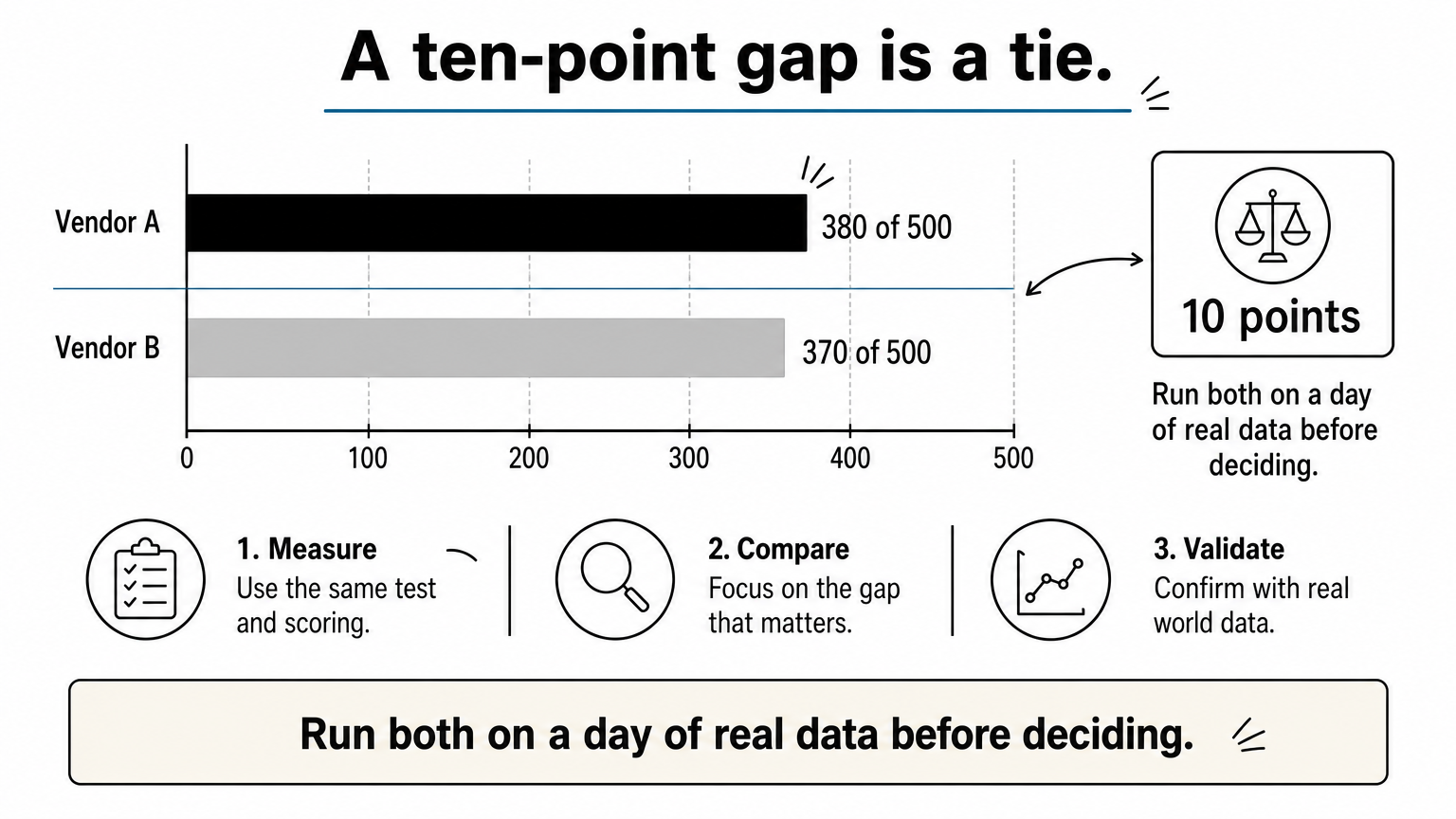
Weight your criteria before any demo, so a good presentation cannot decide for you. Here is an example for a 60-person distributor comparing two vendors, scored 1 to 5.
| Criterion | Weight | Vendor A | Vendor B |
|---|---|---|---|
| VAT and local compliance | 25 | 5 (125) | 3 (75) |
| Inventory and warehouse | 25 | 3 (75) | 5 (125) |
| Integration with current tools | 15 | 4 (60) | 3 (45) |
| Total cost | 20 | 3 (60) | 4 (80) |
| Partner support | 15 | 4 (60) | 3 (45) |
| Total (out of 500) | 100 | 380 | 370 |
A gap of ten points is a tie. When scores are that close, run both vendors on a day of your real data before you decide.
Questions for an implementation partner
A good ERP implementation partner in South Africa can show proof, not promises. Ask these in the first meeting:
- Which clients in my industry have you implemented, and can I call them?
- Can you produce VAT201-ready figures from sample data in the demo?
- Who handles data migration and cleansing, and how is it priced?
- Is the scope fixed, or billed by time and materials?
- Where is my data hosted, and how do you support POPIA obligations?
- What are your support hours and response targets after go-live?
The cheapest partner can become the most expensive if corners are cut on migration and training. Weigh what each quote actually includes.
Choose the ERP that fits your workflow
The best ERP is the one that matches your industry, size and compliance needs, and that a capable local partner can deliver. Freight and logistics teams are best served by a system built for their flow. Large enterprises, Microsoft-centred finance teams and accounting-led SMEs each have a clear match in the picks above.
Score two or three vendors with the same criteria, test VAT reporting with your own data, and vet the partner before you sign. If you run a forwarding, clearing, transport or warehouse operation, request a tailored QuikeFix Freight ERP demo built around your own workflow.