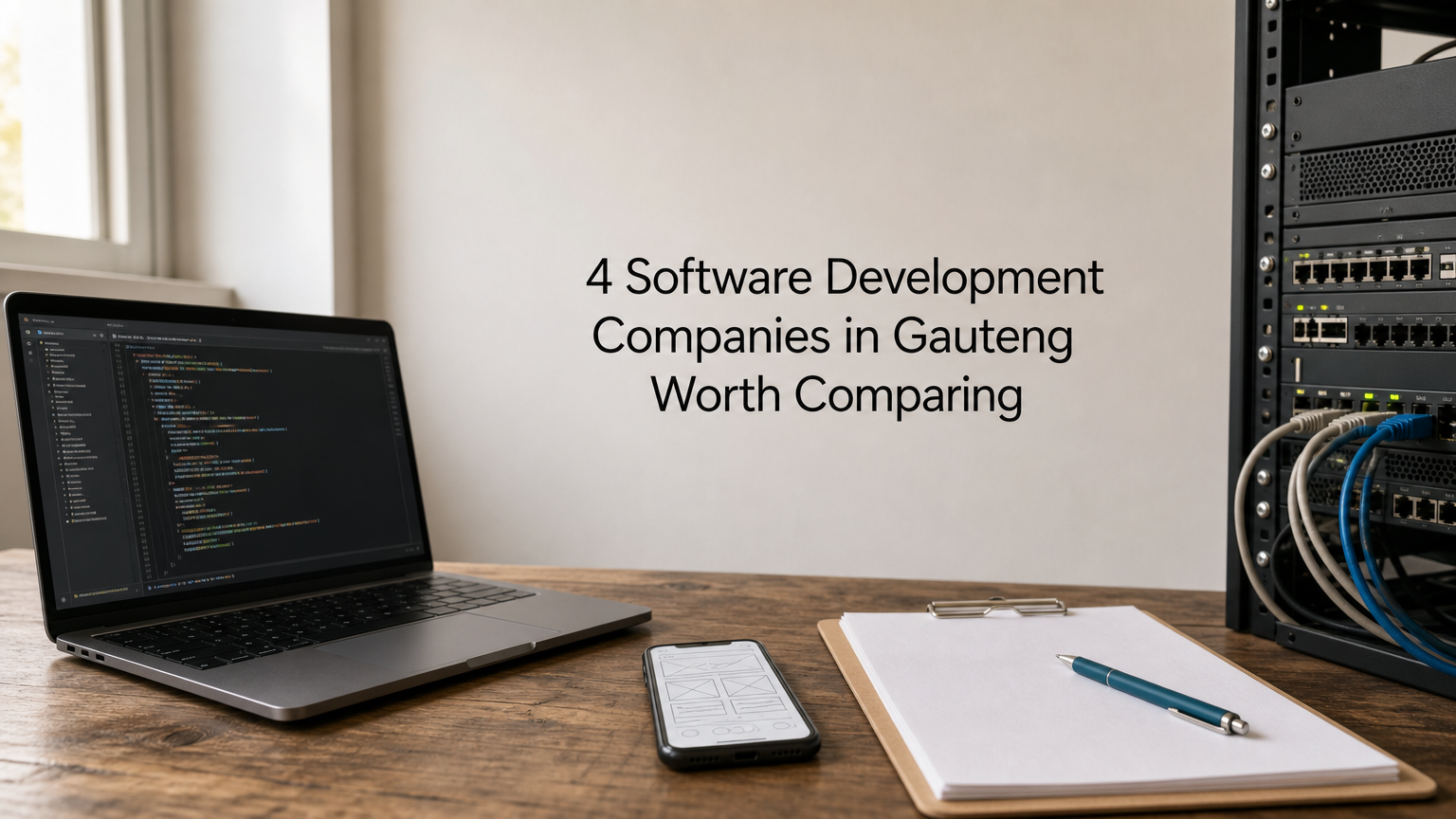
The right software development company in Gauteng is the one whose core work matches your project. QuikeFix suits businesses that want software, hosting and IT support from one provider. Livex suits Pretoria firms that need software alongside network and security work. Netgen fits custom web and mobile builds. Scrums.com fits teams that want to add developers to an existing product.
Choosing is hard because every agency says it builds custom software. The websites look alike, prices are rarely published, and a poor match costs months. Custom software development companies differ mainly in how they work with you, not in the technology they name. You need to know what each one does, who it suits, and what to ask before you sign.
This article covers four providers in or around Johannesburg and Pretoria, then shows how to compare them. QuikeFix publishes this blog, so it is listed first, and you should weigh that. For the other three, scope and pricing change by project, so treat each entry as a shortlist starting point and get a written quote.
1. QuikeFix
QuikeFix suits businesses that want custom software and the hosting and IT support behind it from a single provider.
What QuikeFix builds
The build side covers custom business applications, websites, API integrations, reporting dashboards and workflow automation, including n8n. Hosting, managed IT and cybersecurity sit in the same catalogue, so the team that builds your application can also look after the servers it runs on.
Freight is the specialty. QuikeFix Freight ERP is an Odoo-based system for forwarding, clearing, transport and warehouse teams. It carries SARS-ready customs data and document controls, but direct SARS integration is planned and not active yet.
Who it suits
Small and mid-sized businesses with thin internal IT get the most from it. Logistics firms get a ready product, and other SMEs get tailored applications and automation without juggling separate vendors.
Check the fit on mobile. The catalogue centres on business applications, web, integrations and automation, so a consumer-facing mobile app should be confirmed as in scope in the first consultation.
What to ask before you sign
Pricing is quote-based. Scope, licensing and final price are confirmed in consultation, so there is no public rate card. Send your number of users, locations, current systems, integrations and target date to get a tailored estimate.
Delivery runs through Discover, Design, Implement, and Support and improve. Ask for acceptance criteria in writing at the Design stage, and ask what monitoring continues after go-live.
One vendor for build, hosting and support removes finger-pointing, but only when the scope is written down.
2. Livex
Livex is a Pretoria software development company that pairs development with network management and cyber security.
What Livex builds
Livex lists software development, web design, network management and cyber security as its specialties. That mix means one team can look at both your application and the network it runs on.

Four service lines also raise a fair question. Ask which team would staff your project, and whether the developers are in-house or shared with the network side.
Who it suits
Pretoria and Tshwane businesses that want a nearby team fit best. Workshops and handovers are easier when the developers work in your city, and the IT infrastructure help is useful if your server room needs attention too.
If your project is large, raise team size and capacity early. A firm with several service lines may spread its staff across them, so confirm who is dedicated to your build.
What to ask before you sign
Ask how projects are scoped and priced, and whether post-launch support is a monthly retainer or billed per call-out. Both models are common, and they change your yearly cost.
Then ask who is accountable when an application fault turns out to be a network or security issue. With one provider the answer should be simple, and you should hear it before signing.
A firm that covers software and networks should be able to name one person who owns a fault that crosses both.
3. Netgen
Netgen suits companies that need custom software, mobile apps and web platforms built together.
What Netgen builds
Netgen designs and builds custom software, mobile apps and web platforms that help businesses operate. It has an office in Randburg, Johannesburg, which makes it a practical choice for northern Johannesburg companies.

Covering all three formats matters when your project spans several screens. A customer app, a web portal and a back-office system usually need to share the same data and rules.
Who it suits
Companies that need mobile and web together get the clearest benefit. An example is a field-service business with a technician app, a customer portal and an internal dispatch system.
A business wanting only a simple brochure site will likely find a smaller agency quicker and cheaper. Netgen’s pitch is operational software, so judge it on that kind of work.
What to ask before you sign
Ask for references with live mobile apps, not only web projects. App store releases, update cycles and compatibility with new phone versions all create ongoing work.
Also ask who pays for and performs updates after launch. Mobile apps need regular maintenance, and the quote should state whether that is included or priced separately.
If your project includes a mobile app, budget for maintenance from the first quote, not after launch.
4. Scrums.com
Scrums.com suits companies that already have a product direction and want to add dedicated developers quickly.
What Scrums.com offers
Scrums.com provides dedicated teams, staff augmentation and AI-driven delivery. Its Johannesburg hub is where the company was founded in 2012, so it has more than a decade of operating history.
This is a team-based model rather than a pure fixed-price project. You either rent a whole delivery team or add a few engineers to your own.
Who it suits
It suits businesses with a product owner or technical lead who can set priorities and review work. In that setup, extra developers raise your speed without you managing a separate agency project.
A company with only a vague idea will struggle here. A project-based firm with a design stage is the better match when nobody on your side can direct the developers day to day.
What to ask before you sign
Ask what AI-driven delivery changes in practice. Faster sprints, cheaper code review and better test coverage are different benefits, and you should hear which one applies to your project.
Ask how a developer is replaced if someone leaves mid-project, and how knowledge is handed over. In a team model, continuity is the real product.
With staff augmentation, you buy capacity, so your own direction decides whether that capacity produces results.
How to choose between these providers
Compare these software development firms on engagement model first, then on scope, support and code ownership. All four can build good software, but they sell it in different ways.
Compare them side by side
Whether you call a firm a software development agency or an IT software development company, the label hides the real differences. This table sets the four apart.
| Company | Gauteng base | Core offer | Best fit |
|---|---|---|---|
| QuikeFix | Serves Gauteng | Business apps, Freight ERP, automation, hosting, managed IT | Firms wanting one provider for software and IT |
| Livex | Pretoria | Software, web design, network management, cyber security | Tshwane businesses needing software plus IT |
| Netgen | Randburg, Johannesburg | Custom software, mobile apps, web platforms | Mobile and web builds |
| Scrums.com | Johannesburg | Dedicated teams, staff augmentation | Companies with a technical lead |
Questions that separate strong firms
Put these questions to every shortlisted firm. Some custom software design companies stop at wireframes, so the answers on code and support matter as much as the portfolio.
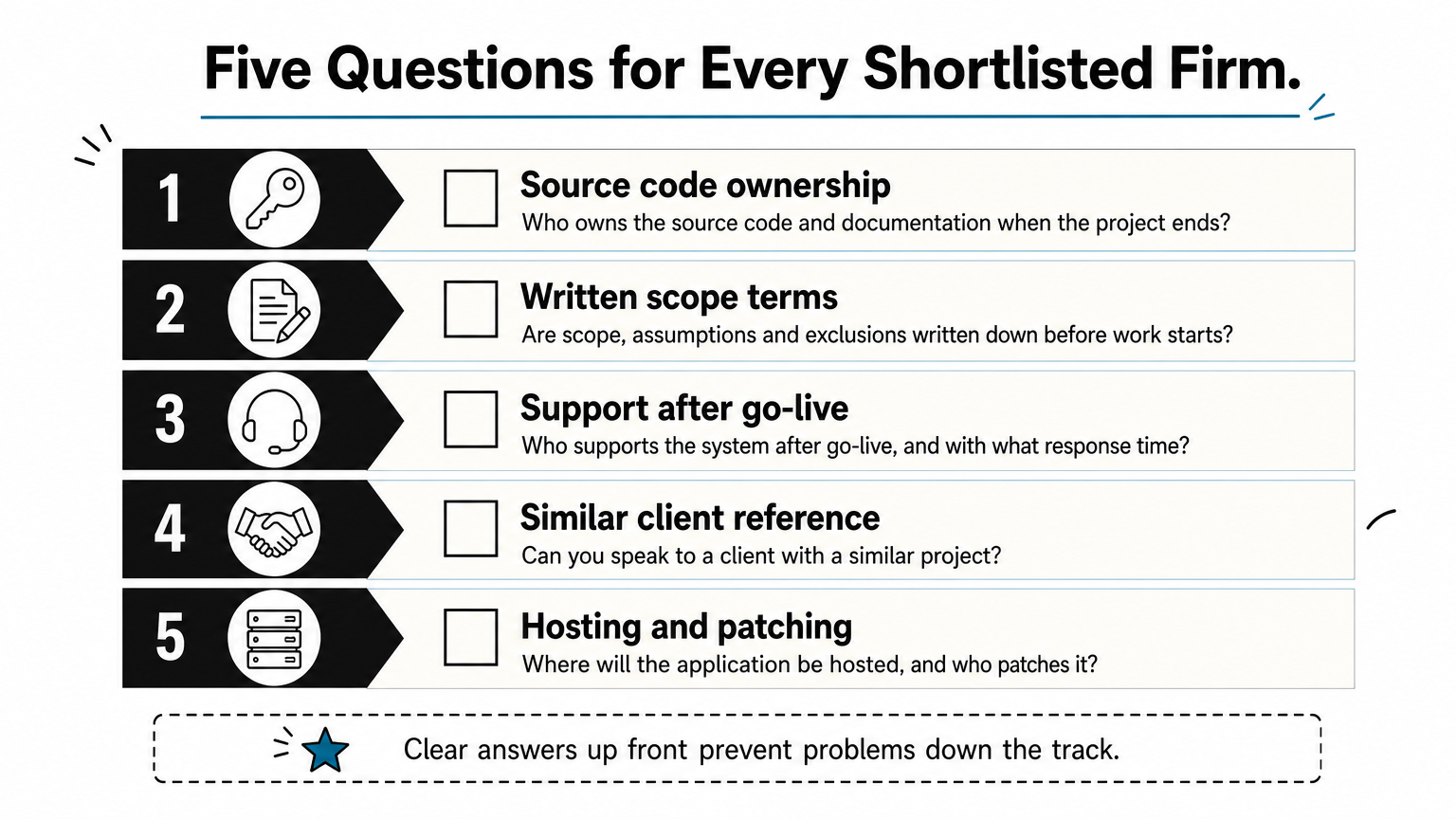
- Who owns the source code and documentation when the project ends?
- Are scope, assumptions and exclusions written down before work starts?
- Who supports the system after go-live, and with what response time?
- Can you speak to a client with a similar project?
- Where will the application be hosted, and who patches it?
What to send in your brief
A clear brief gets you comparable quotes. Copy this and fill it in before you contact any firm.
Business problem:
Number of users:
Locations or sites:
Current systems and data:
Integrations needed:
Target go-live date:
Budget range:
Quotes are only comparable when every firm receives the same brief.
Choosing your development partner
Pick the model that matches your situation. Choose a one-stop provider when you lack internal IT, a local team when meetings matter, a mobile-and-web builder for multi-screen products, and a dedicated-team model when you can direct developers yourself. Then compare written quotes built from the same brief.
If your project is a business application, workflow automation or a freight and logistics system, you can request a consultation or demo with QuikeFix and get a tailored estimate based on your users, systems and target date.